
The life and times of two early Texas Panhandle Pioneers. This is a work in progress, gathering material from many sources. Something is exciting I want to share with you as well, but I am not allowed to release the information until March 6, or so I am told.
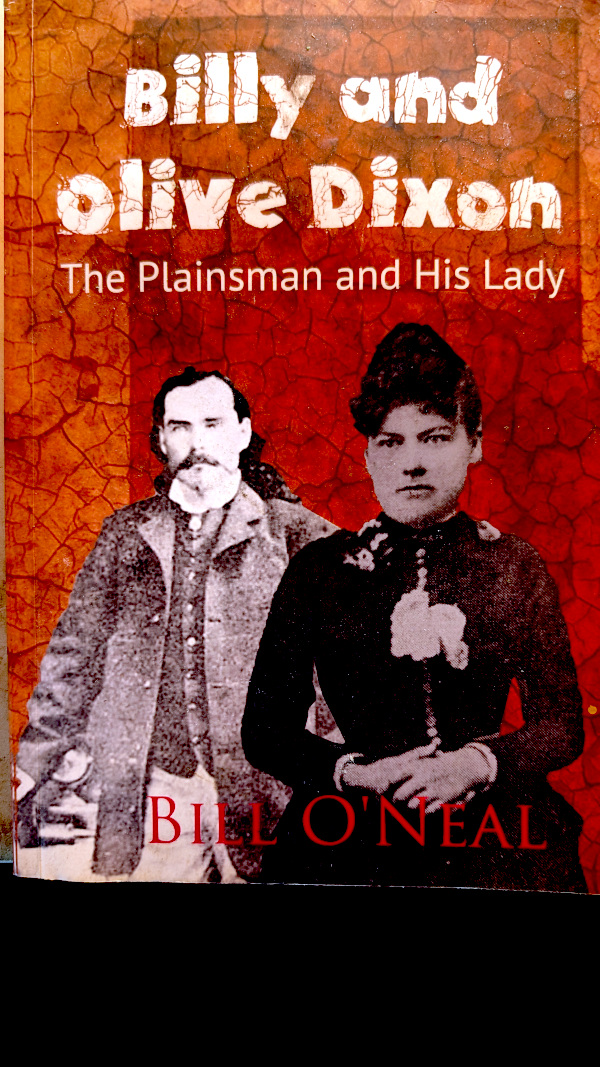
The first resource I would like to share with you is a book written by the former Texas State Historian, Bill O'Neal. The book cover is featured at the top of this page, and I will add a link below so you can purchase it if you like. (I have no connections to any sales) And by the way, Mr. O'Neal passed away in 2025.
I documented Bill O'Neal giving a lecture about his book at the National Cowboy Symposium and Celebration in Lubbock, Texas.
O'Neal mentions in the video above that there was a large group that traveled in buses to the original Adobe Walls site. The video below contains video recorded at the event. It even includes O'Neal giving his presentation.
Summaries of the book using AI
I used this prompt to generate a response from Grok and Gemani, "Create a chapter-by-chapter summary of the book 'Billy and Olive Dixon - The Plainsman and His Lady', by Bill O'Neal
Grok Response
Chapter One: A Panhandle Wedding
This chapter describes the wedding of Billy Dixon and Olive King in the Texas Panhandle in late 1894. It sets the scene in the rugged frontier, highlighting how the 45-year-old shy plainsman met and married the 21-year-old adventurous schoolteacher from Virginia, who had come west to visit her brother and stayed after falling in love with the land. The narrative emphasizes the romantic and historical context of their union amidst the fading Old West.
Chapter Two: The Mysterious Background of Billy Dixon
Focusing on Billy Dixon's early life, the chapter explores his birth in West Virginia in 1850, the death of his parents, and his move to an uncle's home in Missouri. It details his youthful lure to Western adventure at age 14, traveling to Leavenworth, Kansas, to become a bull-whacker on government trains, crossing the Plains to Fort Collins amid hardships like mud and floods, and beginning his frontier experiences without initial encounters with Indians or buffalo.
Chapter Three: Billy’s First Buffalo and First War Party
Billy joins a government mule train to Fort Harker amid a cholera outbreak, breaking wild mules and killing his first buffalo during quarantine. The chapter covers his supply hauls to forts, encounters with vast herds and war parties, and observations of the 1867 Medicine Lodge Treaty negotiations with chiefs like Satanta and Black Kettle, including tensions over buffalo slaughter and prairie fires.
Chapter Four: She Grew Up in the Old South
This chapter shifts to Olive King's upbringing in Virginia during the Old South era. It details her family background, education, and early life influenced by Southern traditions, leading to her decision to venture west to visit her cowboy brother in the Panhandle, where she adapted to frontier life and took up teaching in a sod schoolhouse.
Chapter Five: Buffalo Hunter
Billy transitions to professional buffalo hunting for hides in 1868, hauling munitions for Custer's expedition and dealing with stampedes. By 1872 in Dodge City, he avoids vices, partners with figures like "Cranky" McCabe, and hunts south of the Arkansas River amid Indian scares, establishing ranches, facing blizzards, and contributing to the systematic extermination of herds for profit despite dangers.
Chapter Six: Adobe Walls
Exploring the Texas Panhandle, Billy visits the ruins of the original Adobe Walls trading post. Back in Dodge City, he joins a major 1874 expedition with Bat Masterson and the tempestuous Fairchild, traveling through No Man's Land, crossing rivers with floods and quicksands, and establishing a hunting camp at Adobe Walls, building structures and scouting scarce herds amid pranks and harsh conditions.
Chapter Seven: The Second Battle of Adobe Walls
On June 27, 1874, a thousand Kiowa, Cheyenne, and Comanche warriors, led by Quanah Parker, attack the Adobe Walls camp at dawn after a ridge pole crack alerts the hunters. The chapter details the intense battle: defenders barricade in buildings, repel charges with superior marksmanship, endure ammo runs, and suffer losses like the Shadler brothers and Billy Tyler, with Indians sounding bugles and retreating after heavy casualties.
Chapter Eight: Billy Dixon’s Shot
Continuing the Adobe Walls battle, this chapter highlights Billy's famous "scratch shot" with a borrowed Sharps rifle, killing a Comanche warrior at nearly three-quarters of a mile (about 1,538 yards). It covers ongoing skirmishes, recovery of relics, the death of William Olds, and the hunters' resilience, including Dixon's fall mistaken for a wound and the ominous cawing of a pet crow.
Chapter Nine: Buffalo Wallow
In September 1874, Billy and five companions are ambushed in the Buffalo Wallow Fight, defending a shallow depression against charging Kiowa and Comanche. Amid terrible suffering from wounds and thirst, they hold off attacks until a cold rain saves them; one man dies, and Billy seeks aid, eventually receiving help from General Miles, earning the Medal of Honor for his heroism.
Chapter Ten: Army Scout
Billy serves as a scout under General Miles, returning to Adobe Walls with Lieutenant Baldwin, witnessing Indian killings like George Huffman's. The chapter covers depredations by Quanah Parker, a pleasing story of his dog Fannie, blizzard ordeals, rescues of Germain captives from Cheyenne camps, and a thirsty expedition on the Staked Plains where Billy discovers Double Lakes to save the command.
Chapter Eleven: Back to Adobe Walls
In 1883, Billy returns to civilian life, homesteading at Adobe Walls ruins, building a cabin, irrigating for the Panhandle's first alfalfa and orchard, and serving as postmaster with a store for cowboys. The chapter reflects on his bachelor years amid wildlife, transitioning to changing frontier conditions with the breakup of cattle ranches and influx of settlers.
Chapter Twelve: The Hero of Adobe Walls Meets a New Schoolmarm
This chapter narrates how the renowned hero Billy Dixon meets Olive King in late 1893 through a mutual friend, five miles from her school south of the Canadian River. It explores their courtship, Billy's shyness around women, and Olive's adventurous spirit as a "schoolmarm" who chose to stay in the Panhandle despite family crowding.
Chapter Thirteen: Mr. and Mrs. Billy Dixon
After marrying in 1894, Billy and Olive build a life together, raising eight children on their ranch. The chapter details their family dynamics, Billy's roles as justice of the peace and sheriff, and their collaboration on his memoirs as his health declines from years of frontier exposure, capturing their partnership in the evolving West.
Chapter Fourteen: Widow and Mother
Following Billy's death in 1913 at age 62, Olive becomes a widow and devoted mother, managing the family and completing his autobiography. The chapter covers her challenges raising children alone, preserving his legacy through writings and interviews with old-timers, and adapting to life without him on the Panhandle frontier.
Chapter Fifteen: Panhandle Historian
Olive emerges as a key historian, collecting materials for the Panhandle-Plains Historical Museum in Canyon, writing articles, speaking on pioneer experiences, and erecting monuments at Adobe Walls and Buffalo Wallow. The chapter highlights her role in founding and growing the museum, providing invaluable resources for Southwest history, and her lasting impact as a guardian of frontier stories.
Gemini Fast Response
Part I: Billy Dixon’s Early Years and Adventures
The Runaway Youth: Details Billy’s childhood and his decision to run away to the West as a boy. This section covers his early odd jobs as a woodchopper, trapper, bullwhacker, and muleskinner.
The Buffalo Hunter: Focuses on Dixon’s transition into buffalo hunting, where he developed the legendary sharpshooting skills that would eventually make him famous.
The Second Battle of Adobe Walls (1874): A pivotal section describing the attack by roughly 700 Plains Indians (including Comanches and Kiowas). It highlights Dixon’s "Big Fifty" Sharps shot, which reportedly hit a warrior nearly a mile away.
The Buffalo Wallow Fight: Details the desperate engagement where Dixon and five others fought off 125 warriors. This action earned him the Medal of Honor.
Army Scout and Pioneer: Covers his decade-long service as an army scout before he eventually settled in the Texas Panhandle to build a bachelor home.
Part II: Olive King and the Meeting of Two Worlds
From East to West: Introduces Olive King, an adventure-seeker who moved from the East to the Panhandle to visit her brothers.
The Schoolmarm and the Plainsman: Describes Olive’s life as a frontier teacher and her meeting with her neighbor, the famous Billy Dixon.
A Frontier Romance: Recounts their courtship and marriage, despite a significant age difference (over 20 years).
Part III: Building a Legacy Together
Family Life on the Plains: Focuses on their life together raising eight children on the Texas frontier.
Preserving History: A crucial chapter on Olive's role in persuading Billy to dictate his memoirs. This resulted in the classic biography, Life of "Billy" Dixon.
Olive’s Widowhood and Preservation: Following Billy's death in 1913, this section covers Olive’s decades-long effort to preserve Panhandle history, her work with the Panhandle-Plains Historical Museum, and her efforts to erect monuments at battle sites.
Key Figures & Events
| Entity | Role/Significance |
| Billy Dixon | Legendary scout, buffalo hunter, and Medal of Honor recipient |
| Olive King Dixon | Frontier teacher and author who ensured Billy's history was recorded |
| Adobe Walls | Site of the 1874 battle and Billy’s famous long-range shot |
| Buffalo Wallow | The site of the fierce 1874 battle that resulted in Dixon's Medal of Honor |
There are many resources about the two available, including Olive's book about her husband. I have just about run out of time for creating this page for today, but will add more as time goes along and perhaps with a bit of nudging from you! Contact Us and tell me what you think or want to share.
I was invited to do a short live interview about Billy on KAMR TV in Amarillo, Texas. Click on this link to watch - Sponsored Segment: The Man Behind a Record Setting …
There was a longer recorded interview you can watch via the following link: Panhandle Legends: William ‘Billy’ Dixon, battles …
The Adobe Walls and Buffalo Wallow were just two of several battles that make up the Red River War. I was fortunate to participate in covering several activities commemorating the 130th anniversary of the Red River War. Wes visited three different battle sites, and the Lyman Wagon Train battle was mentioned, but we did not visit that site. I have created a video playlist for the Red River War, listing my three videos and several others from other YouTube channels on the subject. You can watch any or all of those videos just below.
Red River War Video Playlist
My Research Questions
Q1: Can we find the model of the Sharps .50 Cal buffalo rifle Billy used in the second battle of Adobe Walls? I suspect it was the .50-90 Sharps.
Clue 1: .50-90 Sharps | Wikipedia
Clue 2: Shiloh Sharps Rifles | Wikipedia
Q2: Has the rifle been donated to the Panhandle Plains Historical Museum?
Q3: How much historical material generated by Olive is still avaible and is it available online?
LINKS
Book: Billy and Olive Dixon - The Plainsman and His Lady | Eakin Press
Book: Life of Billy Dixon by Olive K. Dixon
Links below are provided by the Texas State Historical Association's Digital Handbook of Texas
The Life and Legacy of William Billy Dixon: Scout and Buffalo Hunter
Dixon, Olive King - Texas State Historical Association
The Red River War: A Conflict Between U.S. Army and Native Tribes
The History of Adobe Walls: Trading Post to Historic Landmark
Adobe Walls, Second Battle of - Texas State Historical Association
The Buffalo Wallow Fight: A Heroic Engagement in the Red River War